
Key Takeaways
- A tax invoice requires everything a standard invoice needs, plus your tax registration number and the tax amount shown as a separate line item — combining tax into your total instead of itemizing it is the most common compliance mistake.
- UK VAT invoices must show your VAT registration number once your turnover crosses £90,000, while US invoices don’t require a tax invoice format at all unless you’re collecting state sales tax.
- A proforma invoice and a tax invoice look almost identical but serve completely different purposes — a proforma is an estimate, a tax invoice is a legal payment demand.
- This guide includes a field-by-field breakdown so you can build a compliant tax invoice from scratch, in any format — Word, PDF, or a free generator.
A freelance consultant based in Manchester lands a new client in Germany and sends over her usual invoice — the same one she’s used for years with UK clients. The client’s finance team emails back asking for her VAT number and a properly itemized tax breakdown, and she realizes her standard invoice format doesn’t actually meet what a cross-border tax invoice requires. This mix-up happens constantly, because “invoice” and “tax invoice” aren’t the same document, and the rules shift depending on which country you’re billing from and which country you’re billing to. By the end of this guide, you’ll know exactly what a tax invoice format needs to include, how the US, UK, and EU rules differ, and how to tell a tax invoice apart from a proforma invoice before you send the wrong one.
What Is a Tax Invoice?
A tax invoice is a formal document that itemizes goods or services provided along with the tax charged on them, and it’s specifically used to document a completed sale for tax reporting purposes — not just to request payment. It differs from a standard invoice by explicitly separating the tax amount as its own line, rather than folding it into a single total.
Why the Distinction Matters More Than It Seems
Plenty of freelancers use “invoice” and “tax invoice” interchangeably, and for domestic US clients without sales tax obligations, that’s usually fine. But once you’re VAT-registered in the UK or EU, or collecting sales tax in a US state that requires it, a tax invoice becomes a specific compliance document your client’s accounting department needs on file — not just a polite request for payment. Missing this distinction is exactly what tripped up the consultant in the opening example: her invoice had a total, but no separated tax line, no VAT number, and nothing that let the German client’s finance team process it correctly on their end.
The Fields a Tax Invoice Format Must Include
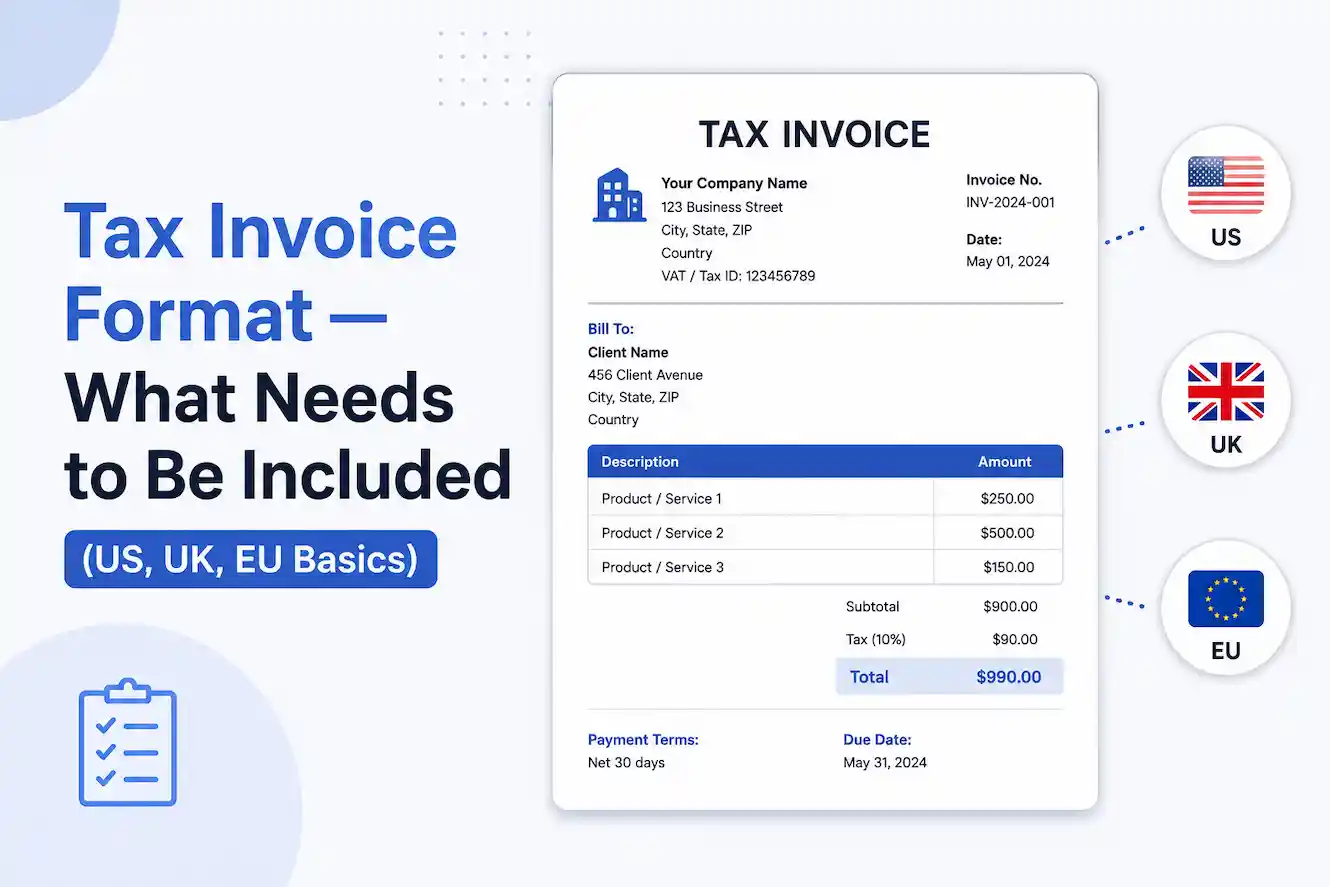
A complete tax invoice needs nine fields: your business name, address, and tax registration number; the client’s name and address; a unique invoice number; the issue date; an itemized description of goods or services; the taxable amount; the tax rate applied; the tax amount as a separate line; and the final total.
| Field | Standard Invoice | Tax Invoice |
|---|---|---|
| Business name & address | Required | Required |
| Tax registration number | Not required | Required (VAT/GST number) |
| Invoice number | Required | Required |
| Itemized description | Required | Required |
| Tax rate shown separately | Optional | Required |
| Tax amount as separate line | Optional | Required |
| Total (pre-tax + tax = final) | Combined is fine | Must show the breakdown |
Why the Separated Tax Line Isn’t Optional
A client’s finance team reconciling a tax invoice needs to see the pre-tax amount and the tax amount as two distinct numbers, because that’s what they enter into their own accounting system for tax reclaim or reporting purposes. An invoice that just says “$1,050 total, tax included” gives them nothing to work with — they’d have to guess your tax rate and back-calculate it themselves, which is exactly the kind of friction that delays payment while their team emails you asking for a corrected version.
Tax Invoice Rules in the US
The US doesn’t have a standardized “tax invoice” format the way the UK and EU do, because federal tax law doesn’t require one — sales tax obligations exist at the state level, and only apply if you’re selling taxable goods or services in a state that charges it.
What US Freelancers Actually Need to Know
Most US-based freelancers providing services (consulting, design, writing) don’t charge sales tax at all, since services are exempt from sales tax in the majority of states — physical goods are a different story and vary significantly by state. If you are required to collect sales tax, show it as a separate line item labeled “Sales Tax” with the specific rate applied, rather than folding it into your rate. For independent contractors, the invoice itself isn’t the tax document that matters most anyway — that’s the 1099-NEC your client issues you once they’ve paid you $600 or more in a calendar year, which is a completely separate form from anything on your invoice.
Tax Invoice Rules in the UK and EU
UK VAT invoices are legally required once your business turnover exceeds £90,000, and they must show your VAT registration number, the VAT rate applied (standard rate is 20%), and the VAT amount as a distinct line separate from your subtotal.
The Compliance Detail Most New Freelancers Miss
If you’re not yet VAT-registered — which is genuinely most freelancers under that threshold — you simply don’t charge VAT at all, and your invoice should say so rather than showing a blank or zero VAT line that looks like an error. Once registered, HMRC requires your VAT number to be clearly visible on every invoice, and combining your VAT into the total instead of itemizing it is one of the more common reasons a UK tax invoice gets rejected by a client’s accounts payable process. EU invoicing follows a similar principle across member states — each country sets its own VAT rate, but the requirement to itemize VAT separately and display your VAT number is consistent across the bloc, since it’s built into EU-wide invoicing directives.
Tax Invoice vs. Proforma Invoice
A tax invoice is a legal demand for payment on a completed sale, while a proforma invoice is a preliminary estimate sent before the work is finalized or goods are shipped — they can look nearly identical in layout, but they mean completely different things to the person receiving them.
Why Mixing These Up Causes Real Problems
Sending a proforma invoice when a client expects a final tax invoice can delay payment, since their finance team may correctly refuse to process an estimate as if it were a completed transaction. A proforma invoice typically gets used for international trade, custom orders, or any situation where final costs (shipping, customs, exact quantities) aren’t fully locked in yet — it lets the client see expected costs and arrange payment or customs documentation in advance, without creating an actual payment obligation until the real tax invoice follows. Label the document clearly: “Proforma Invoice” at the top if it’s an estimate, “Tax Invoice” or “Invoice” if it’s the real, final request for payment. This one-word labeling difference is a bigger deal than it sounds, since a client’s accounts payable software often sorts and processes documents based on that exact header text.
Frequently Asked Questions
What is a tax invoice?
A tax invoice is a document that itemizes a completed sale along with the tax charged on it, showing the pre-tax amount, tax rate, and tax amount as separate line items rather than one combined total.
What information needs to be on an invoice?
At minimum: business details, client details, a unique invoice number, issue date, itemized description of goods or services, subtotal, and total amount — a tax invoice adds a tax registration number and a separated tax line on top of these.
What does an invoice look like in a standard format?
A standard invoice shows business and client information at the top, an itemized table of charges in the middle, and a clear total at the bottom — the exact visual layout varies, but this structure is consistent across Word, PDF, and generator-created invoices.
Is a proforma invoice the same as a tax invoice?
No — a proforma invoice is a preliminary cost estimate sent before a sale is finalized, while a tax invoice documents a completed transaction and its tax details for legal and accounting purposes.
Do I need a VAT number on my invoice if I’m not VAT-registered?
No — if you’re not registered for VAT, you simply don’t include a VAT number or charge VAT at all; adding one you don’t actually have creates a compliance problem rather than solving one.
What’s the standard VAT rate in the UK?
20% is the UK’s standard VAT rate, though reduced rates of 5% and 0% apply to specific categories of goods and services.
Can I create a tax invoice in Word or does it need special software?
Yes, Word works fine as long as the format includes all required fields — separated tax line, tax registration number, and itemized charges — the software you use doesn’t affect legal validity, only the completeness of the fields does.
How do I convert my invoice to a PDF?
Most word processors and invoice generators include a “Save as PDF” or “Export to PDF” option directly in the file menu or download button, which is the standard format expected for sending invoices professionally.
If you’re billing a UK or EU client and aren’t sure whether your current invoice meets tax invoice requirements, check for the separated tax line and your registration number first — those two fields catch most compliance issues before they cause a payment delay. Generate a properly formatted invoice with tax fields built in using our Free Invoice Generator, or read our guide on how to write an invoice for the complete field-by-field basics.
Written by Muhammad Hashir — Founder, NextGen Calculators. Last Updated: July 2026.