
Key Takeaways
- You don’t need a registered business to invoice as a freelancer — your own name, address, and a sequential invoice number are enough to send a legally valid invoice to any company.
- Freelancers who send their first invoice within 24 hours of finishing work get paid noticeably faster, since delay on your end almost always triggers delay on the client’s end too.
- Setting Net 30 by default is the wrong move for most freelance work under $500 — Due on Receipt or Net 7 closes cash flow gaps far faster.
- This guide covers invoicing a company as an individual, what to do if a client asks for a W-9 or VAT number, and the exact fields your very first invoice needs.
A freelance video editor named Marcus lands his first paying client — a small marketing agency that wants three edited reels a month. The work goes fine. Then the agency asks, “Can you send over your invoice?” and Marcus freezes, because he’s never actually made one. He doesn’t have a registered business, he’s not sure what an invoice needs to legally hold up, and he genuinely doesn’t know if he’s even allowed to bill a company as an individual with no LLC behind him. This is the exact moment almost every freelancer hits, and by the end of this guide, you’ll know exactly how to invoice as a freelancer from that very first invoice onward — what fields it needs, how to bill a company as an individual, what to do about taxes, and how to set terms that actually get you paid on time.
Can You Invoice a Company as an Individual?
Yes — you can send a legally valid invoice to a company as an individual with no registered business, LLC, or business license required. Your invoice just needs to include your name, address, a description of the work, and a unique invoice number, the same way any freelancer would document a service they provided.
What Companies Actually Expect From an Individual Freelancer
Larger companies that regularly hire freelancers are used to receiving invoices from individuals, not just registered businesses — their accounts payable departments process these constantly. In the US, if a company pays you $600 or more in a calendar year, they’re required to send you a Form W-9 request so they can issue you a 1099-NEC at tax time; this has nothing to do with whether you’re “official,” it’s simply how the IRS tracks contractor payments. If you’re working with a UK or EU-based client and you’re not VAT-registered (which most new freelancers aren’t, since UK VAT registration only becomes mandatory once your turnover crosses £90,000), you simply don’t include VAT on your invoice at all — trying to add a tax you’re not registered to collect creates more confusion than it solves.
How to Create Your First Invoice as a Freelancer
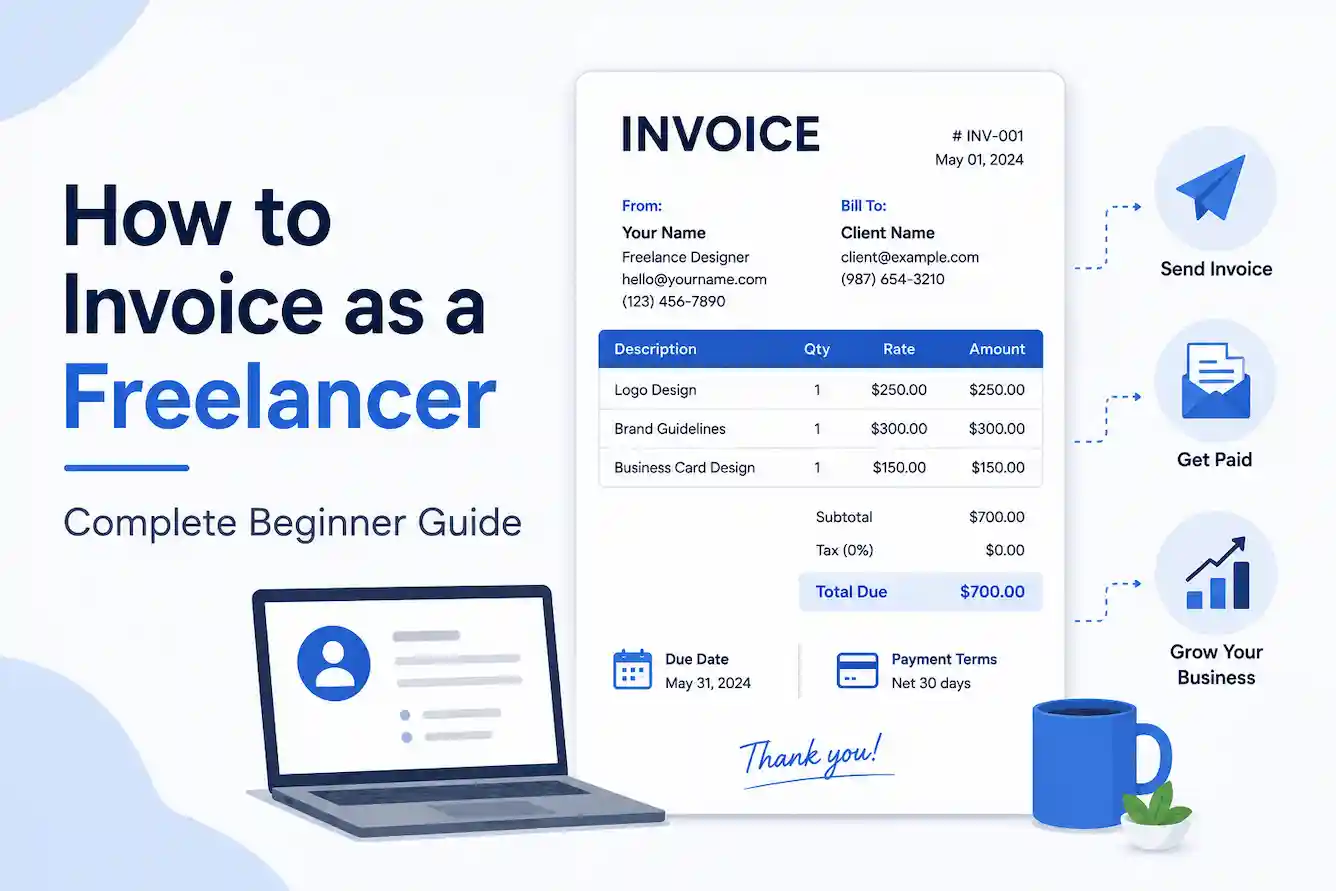
Your first invoice needs seven fields: your name and contact details, the client’s name and address, a unique invoice number, the issue date and due date, a clear description of the work, the total amount owed, and how you’d like to be paid.
| Field | What to Put (First-Time Freelancer Example) |
|---|---|
| Your details | Full name, email, address (business name optional) |
| Client details | Company name, contact person, billing address |
| Invoice number | INV-2026-001 (your very first one) |
| Issue date / due date | Date sent / date payment is expected |
| Description | “Video editing: 3 reels, 60-second format, delivered as MP4” |
| Total | Rate × quantity, clearly shown |
| Payment method | Bank transfer, PayPal, or whatever you actually accept |
The Mistake Almost Every First-Time Freelancer Makes
Vague descriptions. “Editing work — $450” tells a client nothing they can verify against their own memory of the project. “Video editing: 3 reels, 60-second format, 2 rounds of revisions included — $450” gives them something concrete, and it’s the single easiest fix that prevents a confused reply asking what exactly they’re being charged for.
How to Number Your Invoices From Day One
Start with INV-2026-001 for your very first invoice and increment by one for every invoice after that, across every client — don’t restart the numbering for each new client you take on.
Why This Matters More Than New Freelancers Expect
The invoice number matters more than most freelancers realize — sequential numbering that restarts each new calendar year (INV-2026-001 through however many you send that year, then resetting to INV-2027-001) is exactly what accountants and tax authorities expect to see if you’re ever audited or a client disputes a charge. One continuous sequence across all your clients, rather than a separate numbering system per client, is dramatically easier to track once you have more than one or two people paying you regularly.
Setting Payment Terms That Actually Get You Paid
Net 30 means payment is due 30 days after the invoice date, and while it’s the standard most companies expect from established vendors, it’s not always the right choice for a freelancer just starting out.
Why Net 30 Isn’t Your Default
Most freelancers set Net 30 automatically because it sounds professional, but for project-based work under $500, Due on Receipt or Net 7 is more practical and reduces cash flow gaps dramatically — waiting 30 days for a small invoice when you’re just starting out can mean real financial strain that a shorter term avoids entirely. Save Net 30 for larger invoices or ongoing retainer-style work with companies whose internal payment cycles you genuinely can’t influence. State your chosen term explicitly on the invoice itself — “Payment due within 7 days” leaves no room for a client to assume a longer window than you intended.
What to Do If a Client Asks for Tax Documents
If a US client asks for a W-9, that’s a routine request tied to their obligation to issue you a 1099-NEC once they’ve paid you $600 or more in a year — it’s not a sign anything is wrong with your invoice or your setup as a freelancer.
Handling This Without Panic
Fill out the W-9 with your name, address, and Social Security Number or EIN if you have one, and send it back directly to the client, not through the invoice itself. If you’re freelancing internationally and a client asks about VAT, and you’re not registered for VAT in your country, simply tell them you’re not VAT-registered — this is completely normal for a new freelancer and doesn’t prevent you from invoicing them legally. Keep a copy of every invoice you send and every W-9 or equivalent form you submit; these become essential if you ever need to reconcile your reported income against what clients report paying you.
Common Mistakes New Freelancers Make When Invoicing
The most common mistakes are sending invoices late, forgetting to state payment terms explicitly, using inconsistent invoice numbers across clients, and being unclear about what currency you’re billing in in cross-border work.
The One That Costs the Most Money Silently
Freelancers who send invoices within 24 hours of completing work get paid noticeably faster than those who wait, because delay on your end frequently causes delay on the client’s end too — an invoice sent while the work is still fresh gets processed ahead of one that arrives weeks later, competing with the client’s newer priorities. A close second mistake: not stating your currency clearly on international invoices. “$500” is genuinely ambiguous between USD, AUD, and CAD, and specifying “500 USD” removes any chance of a client processing the wrong amount by mistake.
Frequently Asked Questions
How do I invoice as a freelancer with no business registered?
Use your own name and address as the business details on your invoice — a registered business isn’t required to send a legally valid invoice as an individual freelancer.
Can I send an invoice as an individual to a company?
Yes, companies regularly receive and process invoices from individual freelancers with no LLC or registered business behind them, as long as the invoice includes the standard required fields.
How do I make an invoice as a freelancer for the first time?
Include your name and contact details, the client’s information, a starting invoice number like INV-2026-001, the issue and due dates, a clear description of your work, the total amount, and your payment method.
How do I invoice a company as an individual without an EIN?
Use your Social Security Number on any tax forms the client requests (like a W-9), since an EIN is optional for sole proprietors and not required to invoice or receive payment legally.
What happens if I forget to include an invoice number?
The client may still pay you, but you’ll have no clean way to track, reference, or dispute that specific invoice later — always assign one, even on your very first invoice.
Do I need to charge sales tax or VAT as a new freelancer?
Only if you’re registered to collect it — most new freelancers aren’t, and in the UK, VAT registration only becomes mandatory once your turnover crosses £90,000, so simply don’t include it until you’re actually registered.
How long should I wait before following up on an unpaid freelance invoice?
Send a light reminder a few days before the due date, a direct one on the due date itself, and a firmer message about a week after if payment still hasn’t arrived.
Should I use Net 30 for my first freelance invoice?
Not necessarily — for a first invoice under $500, Due on Receipt or Net 7 gets you paid faster and avoids unnecessary cash flow strain while you’re still building your client base.
If you’re about to send your very first freelance invoice, start with INV-2026-001, use Due on Receipt or Net 7 instead of defaulting to Net 30, and send it within 24 hours of finishing the work. Skip the manual setup entirely and generate a complete, professional invoice in under 3 minutes with our Free Invoice Generator, or read our full breakdown of how to write an invoice for the complete field-by-field walkthrough.
Written by Muhammad Hashir — Founder, NextGen Calculators. Last Updated: July 2026.